
Art History and Artistic Periods
Art history deals with the development of art from antiquity to the present day. To better understand the many different art styles, they are divided into so-called artistic periods.
These art periods help identify and compare the typical characteristics, themes, and techniques of a specific era. This makes it possible to understand how artists worked and what ideas shaped their works.
The classification is based on commonalities in style, motifs, materials, and the social conditions of the respective era. The individual periods do not always transition smoothly into one another but often overlap.
Those familiar with art periods can more easily classify works of art and better understand how art has changed throughout history. At the same time, it becomes clear how many design ideas from earlier times are still used today.
What is Art History
Art history deals with the development and study of the visual arts. These include, among other things, painting, sculpture, architecture, drawing, printmaking, crafts, and photography.
It examines what works of art look like, how they were created, and what significance they held for the people of their time. This involves not only viewing individual works but also recognizing connections and tracing developments.
Art history helps us understand and classify works of art and view their creation within a historical context.
What Are Artistic Periods?
Artistic periods are major time frames in art history during which certain characteristics were particularly prominent. These include, for example, recurring themes, materials, or specific ways of understanding and creating art.
This classification helps us better recognize developments over long periods of time. It makes it easier for you to understand how artistic ideas have changed and how older and newer art differ.
It is important to note that art periods do not have fixed boundaries. Transitions are often fluid, and different styles can occur simultaneously or overlap.
➡ Overview of art periods from antiquity to the modern era
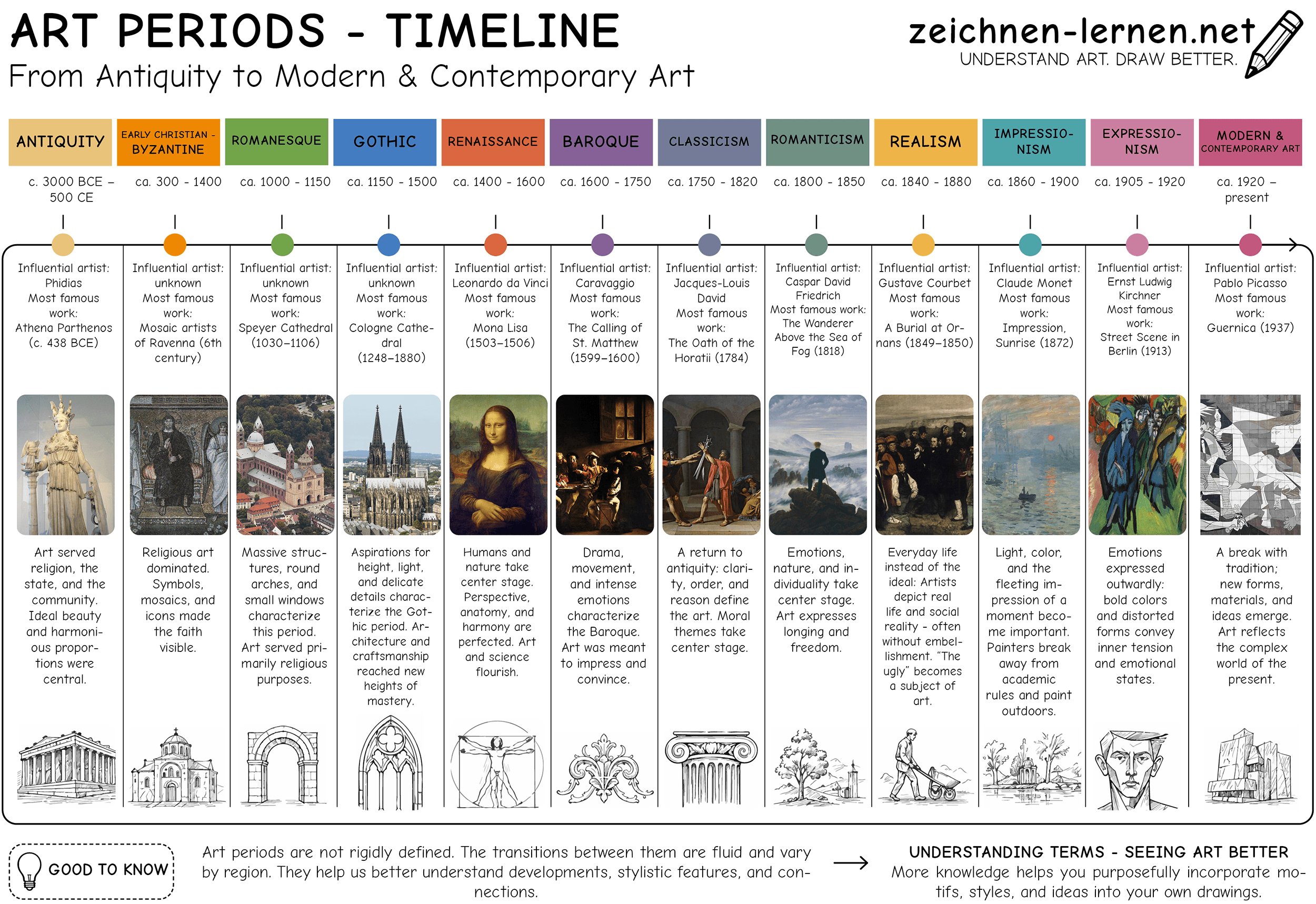
💡 Timeline of Artistic Periods: From Antiquity to the Modern Era
How Artistic Periods Are Categorized
Art history is typically categorized based on several criteria simultaneously. These include chronological sequence, geographical region, shared stylistic characteristics, historical upheavals, and religious or political changes. New technical or material possibilities also play an important role.
The Met therefore describes art history as a chronological, geographical, and thematic exploration. It is important to note, however, that these classifications are not applied uniformly across the globe.
In Western art history, terms such as Gothic, Renaissance, or Baroque are frequently used. Outside of Europe, however, art is often organized more by region, dynasty, or cultural sphere.
Why This Classification Makes Sense
Without such classification systems, individual works of art would stand side by side in isolation, with no discernible connection. Artistic periods, on the other hand, reveal how concepts of beauty, space, the body, religion, nature, power, or individuality have changed over time.
They help us understand that art is never created independently of its time. Every work is related to social conditions, the worldview, patrons, and the technical possibilities of its era.
The division into periods is therefore not an end in itself, but a tool. It helps us trace developments and better recognize connections between change and artistic expression.
What Is Generally Important
Fundamentally, it is important to recognize that art history is not merely a list of famous names. Materials, workshops, functions, pictorial themes, and religious and political contexts are equally relevant. The question of for whom a work of art was created also plays a central role.
The terms used to define historical periods serve primarily as a guide. They make complex developments easier to understand, but they never fully capture reality. Art cannot always be clearly classified into fixed categories.
Many works only partially fit into such classifications, and artistic developments often vary greatly from region to region. Therefore, art history should always be viewed as a tool for understanding and not as a rigid system.
Why This Knowledge Is Still Important Today
Knowledge of older art remains important today because images, forms, and motifs from the past continue to influence the present. In architecture, advertising, design, film, photography, and digital imagery, older visual traditions are constantly being revisited, often without this being immediately apparent.
Those familiar with art historical contexts can better recognize and contextualize such references. This allows for a more conscious perception of visual language, and creative decisions can be more clearly understood and evaluated.
At the same time, art history connects people, ideas, and cultures across many centuries. It makes it clear that images are not merely representations, but also carriers of memory, power, knowledge, and diverse perspectives on the world.
Brief Overview
Art history examines works of art within their respective historical contexts. Artistic periods help to place these works within a broader framework.
This classification serves to clarify developments, differences, and transitions. It is important to note that periods provide orientation but never fully capture the entire diversity of art.
This is precisely why art history remains significant today. It sharpens our eye for images, forms, cultural contexts, and the long history of visual design’s impact.
Artistic Practice
Commission, Purpose, and Dependency
Many important works of art were not created out of pure personal freedom, but rather commissioned by the church, rulers, cities, or private patrons. These patrons often had a strong influence on what a work looked like, which theme was chosen, and where it would later be displayed. Especially in the case of frescoes or altars, the work was firmly tied to a specific location and not intended for free sale.
For you, this shows that external conditions directly influence the design and are not merely a backdrop.
Workshop Instead of the Lone Genius
The common image of the artist working alone often does not reflect historical reality. Many artists were part of large workshops where students, assistants, and other collaborators contributed to the works. Leonardo da Vinci, too, ran such a workshop. Numerous works of art were therefore not created by a single person alone, but through collaborative effort.
For you, this shows that collaboration and the division of labor have always been an important part of artistic practice.
Sketch, Preliminary Drawing, and Revision
Usually, you only see the finished picture. The process leading up to it often remains invisible. However, research shows that many works contain preliminary sketches and revisions. Artists often adapted their ideas as they worked.
For you, this means that mistakes or changes are not a problem, but a normal part of the creative process.
How Materials Change Over Time
Colors and materials don’t always stay the same. They can change over the years. That’s why museums have to pay close attention to light, temperature, and air quality to ensure that artworks are preserved.
This is important for you because the choice of materials not only determines the look of a piece but also affects how long it will look good.
A reproduction is not the original
An image on a screen or in print is never exactly like the original. The color, surface, and effect in a room can differ significantly.
For you, this means that you always perceive originals differently than digital images, and you should take this into account when making your own decisions.
Symbolic Language and Pictorial Symbols
Many works of art make use of symbols and established pictorial symbols. These can tell stories or convey specific meanings. One example is the dove, which symbolizes peace or the Holy Spirit. Another example is the skull, which often serves as a reminder of mortality and death.
This is helpful for you because such visual codes are still frequently used today in advertising, design, and illustration.
Copying as a Learning Method
Copying is often underestimated, but it is an important learning method. Anyone who carefully reproduces a work learns a great deal about technique, composition, and materials.
For you, this can be a good exercise to sharpen your own eye and skills.
Origin and History of Artworks
A work of art often has a long history of ownership, sales, and changes in location. This so-called provenance can reveal a great deal about who owned the work, how it was used, and why it is found in a particular place today. The history of its provenance is therefore an integral part of the artwork and can influence its cultural and historical value. A well-known example is Leonardo da Vinci’s “Mona Lisa.” The painting was initially owned by the French king and later became part of the Louvre’s collection in Paris.
For you, this means that art is not only created in the studio but is also shaped by its journey through time.
Who is represented in art history?
Not all groups have been equally visible in art history. Many artists, particularly those from certain social or cultural backgrounds, were long overlooked. There are several reasons for this:
- First, in the past, many people did not have equal access to education and artistic professions.
- Second, works were often collected, exhibited, and documented by men, which meant that other voices received less attention.
- Third, numerous works were lost or were not considered significant.
This is important for you because it allows you to broaden your perspective, learn about different viewpoints, and look beyond just the well-known names.
Location and Function of a Work
Many works were created for a specific space or purpose. A fresco is painted directly onto a wall; an altar is usually an integral part of a church.
For you, this shows that a work is always shaped by the place for which it was intended.
Modern materials aren’t necessarily easier to work with
Modern materials also come with their own specific properties, possibilities, and limitations. They influence how a piece looks, how it can be worked, and how it changes over time. Every paint and every medium behaves differently and changes over time.
For you, this means you should choose materials consciously, not just based on the effect they produce, but also on how they behave.
Health and Responsibility
Many old and even modern materials can pose health risks. Some paints used to contain toxic substances like lead or mercury, and even today, solvents, sprays, or certain plastics can harm your health if used improperly. That is why it is important to take protective measures, such as ensuring proper ventilation, wearing gloves, or using appropriate work clothing. Proper disposal of paint residues and chemicals is also part of this.
For you, this means that working responsibly is not just about design, but also about handling materials safely and taking care of your own health and the environment.
Particularly useful information for today’s artists
From today’s perspective, five areas are of the greatest practical importance.
- How materials behave over time
Materials change. Colors can fade (e.g., due to sunlight or air), surfaces age, and not every technique remains stable. - Process knowledge and working methods
Art is rarely created in a single step. Sketches, revisions, corrections, and even copies are traditionally part of the process. Workshops and collaboration also play a major role. - Location, commission, and audience
A work is never created in a vacuum. The client, intended use, and location directly influence its form, size, and content. - Visual Language and Symbolic Systems
Images often function through recognizable signs and cultural codes. These can convey stories or meanings that go beyond the mere motif. - Provenance, Canon, and Ethical Questions
A work’s origin, its selection in art history, and the question of responsibility play a major role today. Not everything that is known has been handed down completely or neutrally.
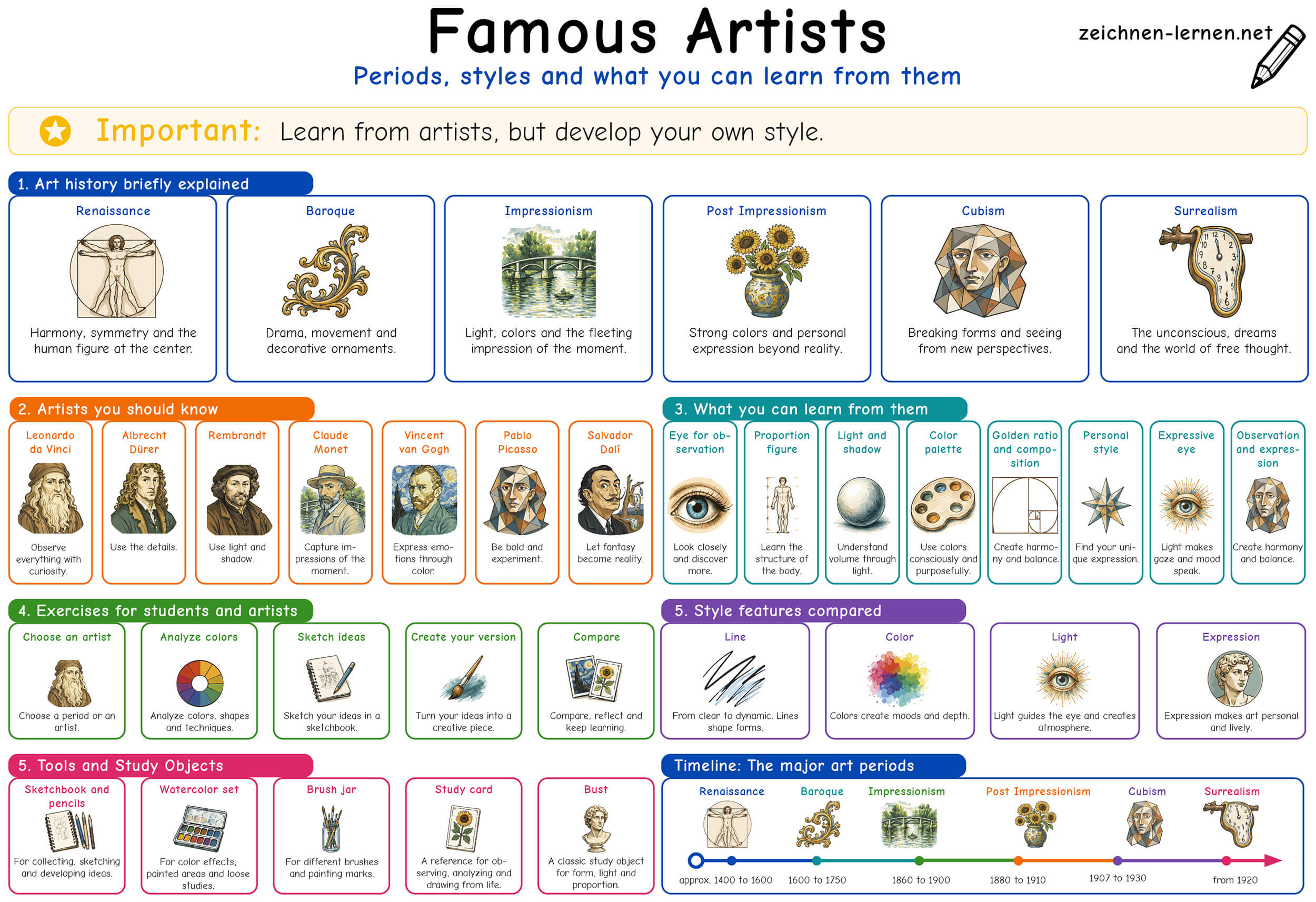
💡 Download the well-known overview as a PDF
The real blind spot, then, does not lie in further categorizing historical periods, but in the practical realities of art itself. Who pays for the work, how is a piece of art actually created, how do materials change over time, and to what extent do museums, reproductions, and the canon shape our contemporary perspective? It is precisely through this understanding that we gain the greatest insight into the present.
➡ More on art in the 20th and 21st centuries
More pages